Finances
What the yard spends on, why a result can be withheld until it's trustworthy, and what a cost billed to a horse's owner means.
VoorBeheerders
Op deze pagina
Finances answers two questions: did the yard make money this month, and can you trust that number? It's where rent, hay, wages, the farrier's bill and every other thing the yard spends on lives — alongside what it earned — so the month's real result is one page, not a spreadsheet you keep on the side. Only admins can open it.
What counts as a cost
A cost is anything the yard pays for: feed and bedding, the vet or farrier, rent and utilities, staff wages, insurance, tools and repairs. Each one gets a category, an amount, a date, and — if you have one — a supplier from your contacts and an invoice or document number, so you can find the entry again when your accountant calls.
Every cost belongs to one of two places:
- The yard — nothing about it is billed to anyone, and it doesn't land on any single horse's numbers. Rent, feed bought in bulk, and utilities are yard costs even though they exist because of the horses.
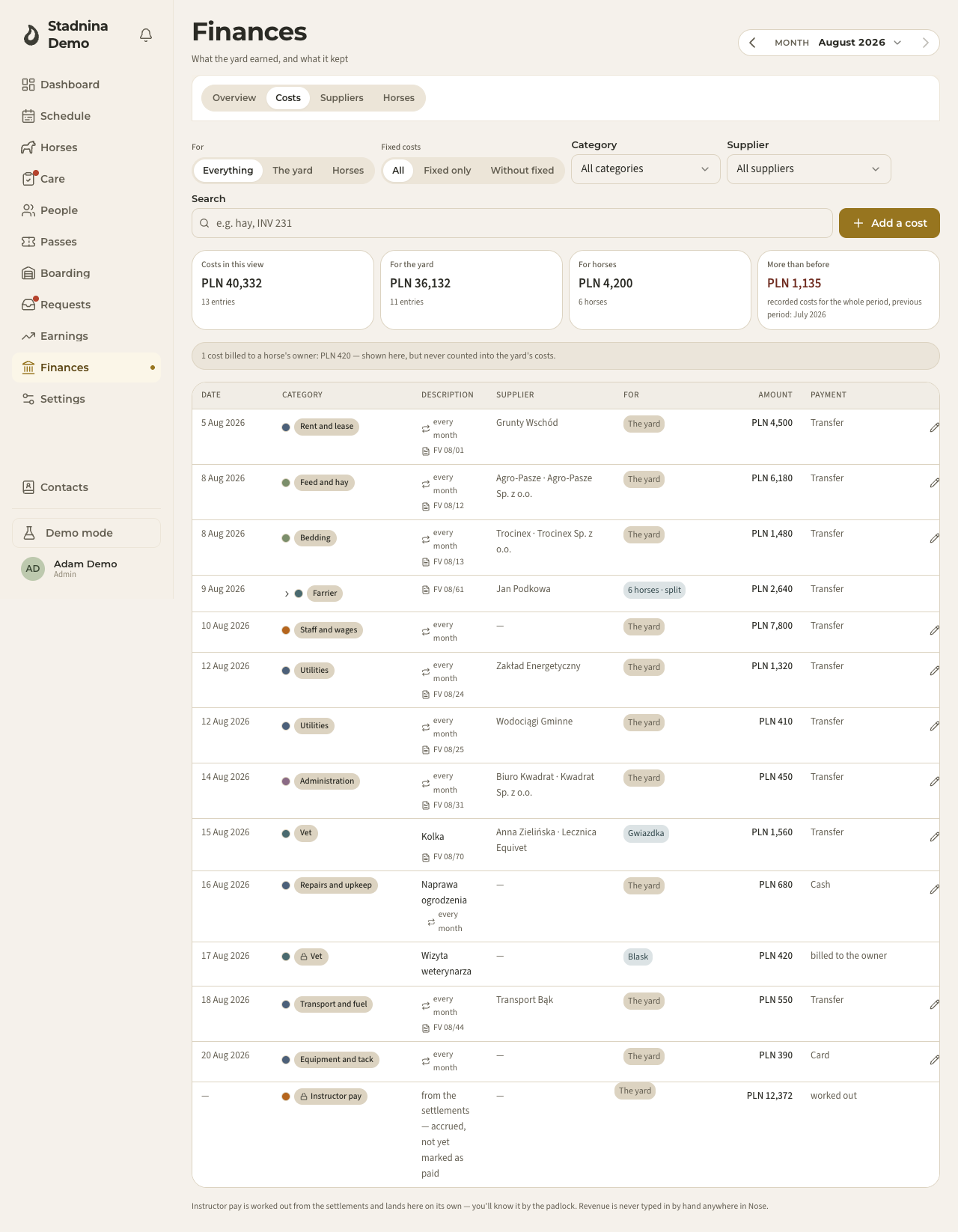
- One horse, or several — a vet visit, the farrier, or anything else that's clearly about a particular horse. A cost that covers several horses at once — the farrier doing six in one visit — splits across them; Costs shows it as one line you can expand, and each horse's own page shows its share.
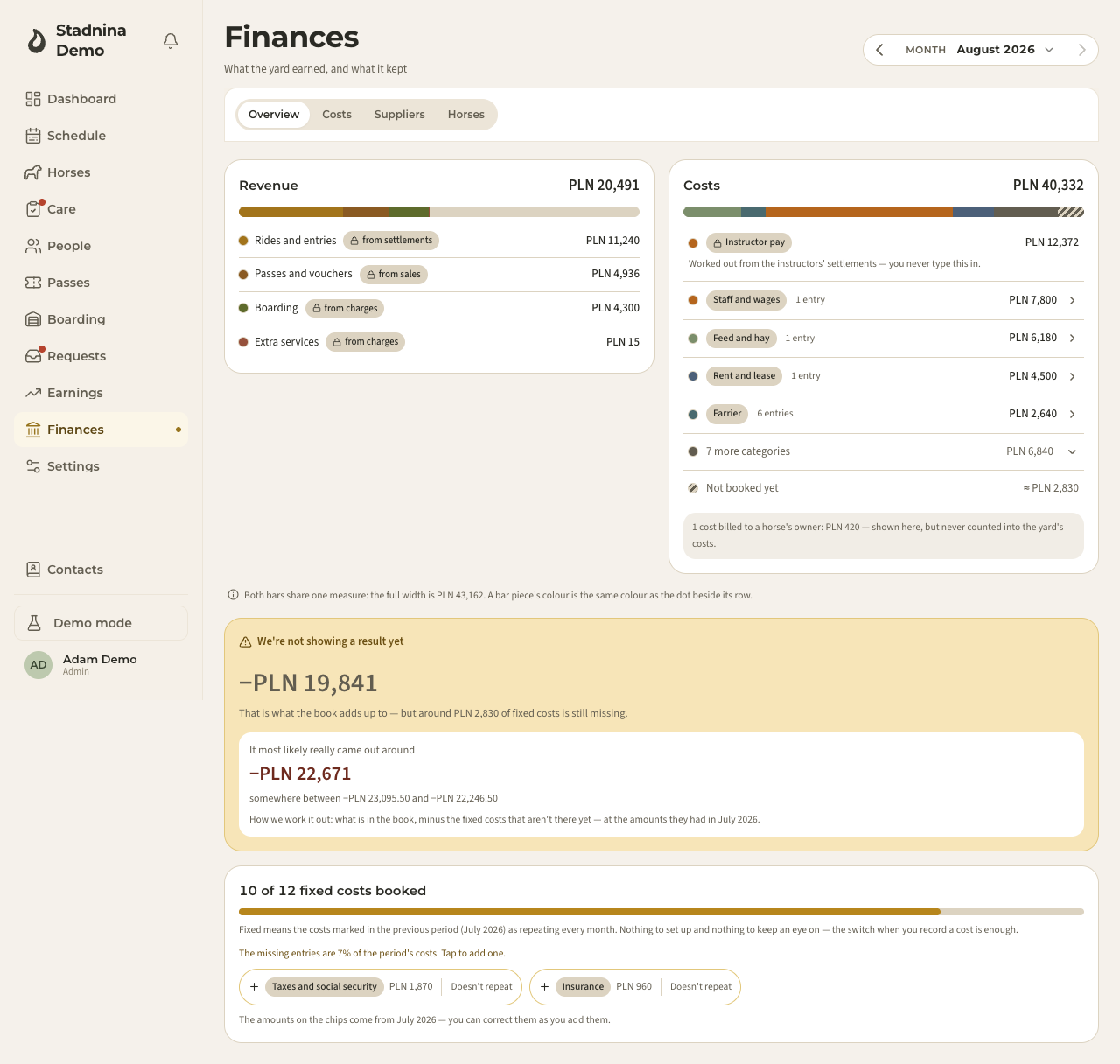
Instructor pay is the one cost you never type in yourself: Nose works it out from the settlements on the Earnings page and adds it here on its own, marked with a lock so you know not to look for a "record it" button.
Fixed costs, and the completeness meter
Some costs come back every month — rent, the internet bill, a supplier retainer. Ticking Repeats every month on a cost tells Nose to expect it again next period. It doesn't fill anything in for you automatically: rent might stay the same for a year, but electricity and hay rarely do, so each month you still confirm the real amount.
The Overview tab keeps count with a simple meter: N of M fixed costs booked. When something expected hasn't shown up yet, a chip lets you add it in one tap, pre-filled with last period's category, supplier and amount — you only need to confirm it's still right. If a cost genuinely doesn't repeat (an annual invoice you ticked by mistake, say), Doesn't repeat on its chip tells Nose to stop expecting it, so it doesn't sit there unbooked forever.
When Nose won't show you a result
If real fixed costs are still missing for the period, Nose doesn't quietly show you a number that's too high — it says so: "We're not showing a result yet", together with what the book adds up to so far and roughly how much is still missing. Instead of a false result, you get an honest estimate — a range, not a single confident figure — worked out from what's already booked plus last period's amounts for what isn't. Add the missing costs and the estimate turns into the real number.
This refusal is deliberate: a wrong number that looks confident is worse than an honest "not yet". Once every fixed cost for the period is in, the meter reads complete and the result is the number itself, no estimate attached.
A cost billed to a horse's owner
Boarders sometimes get billed directly for something done to their horse — a vet visit, for instance — recorded from the care board rather than typed into Finances. That cost still shows up here, on the Horses tab, in that horse's own panel, under The horse's owner covers, but it moves neither that horse's result nor the yard's: the money passes straight through the yard to the owner's invoice, so it was never really the yard's cost or the yard's revenue. Finances always states the passed-through amount as its own line rather than leaving it out silently.
You can't record this kind of cost from Finances directly — the care board is the only place that creates the matching charge, so that's where it's entered.
Good to know
- Finances is admin-only; instructors, helpers, riders and horse owners never see it.
- Costs created automatically from care — an absorbed vet visit, a health-round charge — show a lock in the Costs list: they can't be edited or deleted here, only from where they came from.
- There's no month-close. The page always shows the current, best available picture for the period you're looking at — recording a cost later simply updates it.
- Finances doesn't see your bank account, so it can't tell you what you actually have to spend — only what's been recorded as earned and spent. "Payment" on a cost is just a note for your own records, not a real money movement Nose tracks.
- There's no VAT, invoicing, or tax filing here — a document number and a note are for your own reference, not for a faktura or a KSeF submission.
- Categories are a fixed list, not something you can add to — pick the closest one and use the description field for the specifics.
Related
- Earnings — what each instructor is owed, on the other side of the yard's money.
- Health reminders — where a boarder's vet visit is recorded and billed to its owner.